
LEED AP ND Exam Guide: LEED v4 Content and Practice Tests
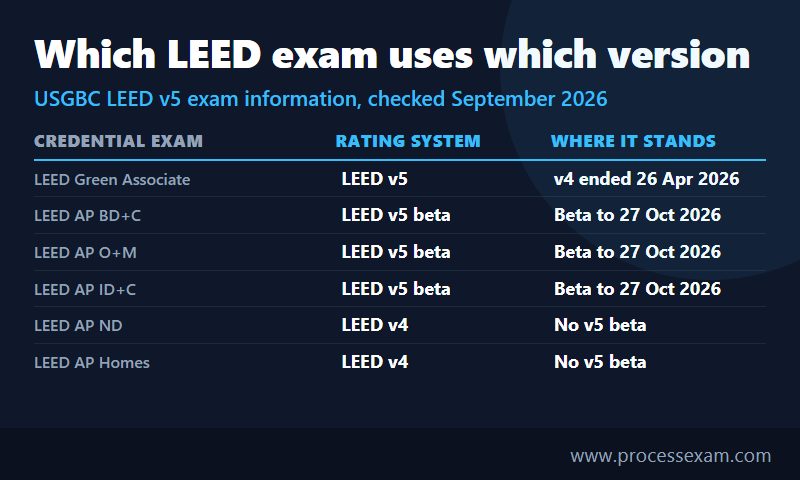
Most LEED study advice published this year opens with LEED v5, and for Neighborhood Development candidates it is aimed at the wrong exam. USGBC moved Green Associate, BD+C, O+M and ID+C onto LEED v5 during 2026 and left Neighborhood Development exactly where it was. GBCI's candidate handbook, updated September 2026, still heads its section "LEED AP ND v4 exam specifications". So your exam is unchanged: 100 questions, 120 minutes, 170 out of 200 to pass.

That single fact decides what you should buy, read and practise for the next two months. It also explains why so much recent commentary is unusable: a reference guide written for the v5 credit library will teach you credits that your exam does not test, and a course sold as "updated for LEED v5" may simply not cover the Neighborhood Development rating system at all.
This guide is written for planners, landscape architects, civil engineers, developers and municipal staff preparing for the LEED AP Neighborhood Development specialty. It sets out what USGBC confirms about the exam's version, what the five content areas actually contain, how the combined and specialty-only routes differ, and an eight-week plan you can start this weekend.
Did the move to LEED v5 change anything for LEED AP ND candidates?
No, and USGBC says so in two places. Its LEED v5 exam information page lists the professional exams that were rebuilt around the LEED v5 rating systems – LEED Green Associate, LEED AP BD+C, LEED AP O+M and LEED AP ID+C – and then states plainly that the LEED AP ND and LEED AP Homes exams will continue to be based on the LEED v4 rating system. The LEED AP with specialty page makes the same point from the other direction, noting that LEED v5 is currently available for BD+C, ID+C and O+M. We checked both in September 2026.
The dates are worth knowing even though they do not apply to you, because they explain the noise. Green Associate candidates lost the LEED v4 version of their exam on 26 April 2026, sat a beta between 28 April and 30 June 2026, and are waiting on the final LEED v5 Green Associate exam. The three v5 specialty exams stopped offering LEED v4 on 28 June 2026 and are running a beta that closes on 27 October 2026, with opt-in registration shutting on 21 October 2026 and scores held until the final exams arrive. None of that touches Neighborhood Development.
What this means for your study material
Three practical consequences follow. First, a LEED v4 Neighborhood Development reference is still the correct reference, not an out-of-date one. Second, anything describing the eight-domain v5 outline, the three impact areas or embodied carbon as an exam topic belongs to a different specialty; read it for professional interest if you like, but do not let it displace your revision. Third, the terminology on your exam is v4 terminology – Smart Location and Linkage, Neighborhood Pattern and Design, Green Infrastructure and Buildings – and answer options will be written in exactly those words.
One caution. USGBC has said nothing publicly about when, or whether, a LEED v5 Neighborhood Development rating system and its matching exam will appear. Treat the current position as stable for your test window rather than permanent, and check the v5 exam information page again a fortnight before you book.
What does the LEED ND rating system actually ask a project team to decide?
Every other LEED specialty asks about a building. Neighborhood Development asks about everything between the buildings, and candidates who come from a building background usually find that the hardest adjustment. The unit of analysis is a project boundary that may hold dozens of parcels, several streets and a mix of owners, and the questions are about the pattern those pieces make.
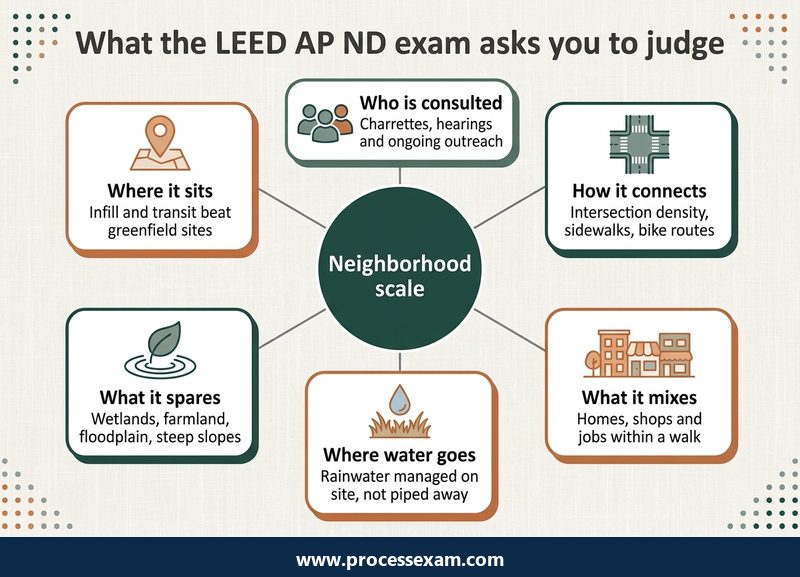
The LEED for Neighborhood Development rating system organises those judgments around a small number of recurring arguments. Where a project sits matters more than what it is made of: an infill site on an existing transit corridor starts ahead of a greenfield site with better building specifications. How the street network connects matters in measurable terms, through intersection density, continuous sidewalks, through-connections and the absence of gates. What the project mixes matters, because homes, shops, schools and jobs within walking distance are what turn density into walkability rather than congestion.
Two more arguments run underneath. The first is avoidance: wetlands and water bodies, imperiled species habitat, prime farmland, floodplain and steep slopes are things a project earns credit for staying away from, and the exam expects you to recognise each category by its technical definition. The second is process: charrettes, pre-design meetings, public hearings and continuing communication are credited work, not paperwork, and the small Project Surroundings and Public Outreach area exists precisely to test whether you understand how a neighbourhood plan meets zoning, land use amendments and the federal agencies that shape them.
Why the scale change trips people up
A candidate used to building-level LEED will instinctively reach for a design answer – better glazing, a more efficient plant – when the question is asking about location, connectivity or land. Train yourself to ask, for every scenario, whether the answer lies in the site's relationship to the city around it, in the arrangement of the streets and blocks, or in the buildings themselves. That one habit sorts a surprising share of the exam.
Which of the five AP ND content areas deserves the most of your study time?
USGBC publishes the question count for each area, so the answer is not a matter of opinion. The five areas together account for 85 of the questions you will see, and the handbook notes that the exam contains both scored and unscored questions – the remainder are pretest items that do not affect your result. The weighting looks like this.
| Content area | Questions | What it turns on |
|---|---|---|
| LEED Process | 13 | Scorecard components, project and LEED boundaries, prerequisites, minimum program requirements, integrative process, innovation and pilot credits |
| Smart Location & Linkage | 21 | Infill and transit-served locations, connectivity, brownfields, bicycle networks, jobs-housing balance, and the sensitive features a project must avoid |
| Neighborhood Pattern & Design | 23 | Walkable streets, compact development, mixed use, housing diversity and affordability, civic space, local food, visitability and stakeholder engagement |
| Green Infrastructure & Buildings | 21 | Renewable energy, district energy, infrastructure efficiency, certified green buildings, water use, heat island and rainwater management |
| Project Surroundings and Public Outreach | 7 | The planning process, zoning and land use amendments, public hearings, and the government agencies involved |
Neighborhood Pattern & Design and Smart Location & Linkage are 44 of the 85 between them, so more than half your revision belongs there. Green Infrastructure & Buildings is the area where building-trained candidates are already strong and where planners usually need the most work, particularly on infrastructure energy efficiency and rainwater management. Project Surroundings and Public Outreach carries only seven questions, but it is also the smallest body of material, which makes it the cheapest marks on the paper – do not skip it because it looks minor.
The full topic list under each area, down to the individual credits and the examples USGBC gives for them, is set out on our LEED AP ND exam syllabus page. Work through it with a highlighter and mark every term you could not define aloud; that list, rather than a generic reading plan, is what your first fortnight should attack.
How to read a weighting without over-reading it
Question counts tell you where the marks are, not how hard they are. Seven questions on the planning process may take an afternoon to prepare; 23 on Neighborhood Pattern & Design will take a fortnight because the credits carry thresholds, index scores and defined categories that all have to be recalled precisely. Budget by difficulty as well as by count, and revisit the weighting after your first practice test, when you will know which areas cost you marks rather than which ones look big.
Should you register for the combined exam or the specialty-only exam?
The route depends on what you already hold. GBCI's September 2026 handbook sets out three eligibility conditions for any LEED AP with Specialty credential: you must be at least 18, you must hold an active LEED Green Associate credential at the point of registration or an active LEED AP with Specialty credential, and you must agree to GBCI's disciplinary and exam appeals policy and to the credential maintenance requirements. The handbook adds that the Green Associate condition is waived if you register for the combination exam, and that prior experience on a LEED-registered project is strongly recommended rather than required.
So the specialty-only exam is the route if you are already a LEED Green Associate or already hold another LEED AP specialty. The combined exam is the route if you hold neither, and it puts the Green Associate section and the Neighborhood Development specialty section into one appointment, 100 multiple-choice questions per section.
The wrinkle nobody warns combined candidates about
Because the Green Associate exam moved to LEED v5 in 2026 while the Neighborhood Development specialty stayed on LEED v4, a combined sitting now spans two rating system versions. Practically, that means two different vocabularies to hold in your head on the same day, and two different sets of study material. Confirm with GBCI at the point of registration which version each section uses before you buy anything, and if the answer is anything other than the one you planned for, sit the two exams separately.
Our own advice for anyone without the Green Associate credential is to take it first and on its own. The Neighborhood Development specialty is demanding enough without a second syllabus attached to it, and passing Green Associate early gives you a credential to put on a proposal while you keep studying.
What does the LEED AP ND exam cost, and how is it delivered?
These are the figures to plan around. They come from our exam records and match what USGBC publishes on its LEED AP with specialty page.
| LEED AP ND exam detail | Value |
|---|---|
| Credential | Certified LEED Accredited Professional Neighborhood Development (AP ND) |
| Exam code | AP ND |
| Vendor | USGBC |
| Number of questions | 100 |
| Duration | 120 minutes |
| Passing score | 170 out of 200 |
| Exam fee | Combined exam: $550 ($400 for USGBC members) Specialty only: $350 ($250 for USGBC members) |
| Rating system version | LEED v4 |
Member pricing is the cheapest lever you have. Linking your USGBC member organisation to your site account before you register turns $350 into $250 on the specialty-only exam and $550 into $400 on the combined one, and many employers in planning and design are already members without their staff realising it. Check before you pay.
Delivery is your choice of a Prometric test centre or a remotely proctored online sitting through Prometric's ProProctor application. The online option removes the travel but adds its own requirements, so read the handbook's environment rules well before the day rather than the night before. The retake policy is worth knowing in advance too: after three unsuccessful attempts within 12 months you must wait 90 calendar days before registering again, with the 12-month period starting at your first failure and the 90 days at your third.
Before you pay for a seat, find out where you actually stand. Sitting a full-length AP ND practice exam under the real 100-question, 120-minute constraint is the most honest measure of readiness you can get before you pay, and it names the content area that is quietly costing you marks.
How do you turn eight weeks into a workable LEED AP ND study plan?
Eight weeks at roughly an hour a day suits a working professional with some LEED exposure. Stretch it to twelve if the Neighborhood Development rating system is new to you, and compress it to five or six only if you have worked on a registered ND project.
| Weeks | Focus | Finish the week able to |
|---|---|---|
| 1 | LEED Process and boundaries | Draw a project boundary against a LEED boundary and explain prerequisites, minimum program requirements and the scorecard |
| 2–3 | Smart Location & Linkage | Judge a site on infill status, transit service, connectivity and bicycle network, and name every sensitive feature category by its definition |
| 4–5 | Neighborhood Pattern & Design | Work through walkable street requirements, compactness thresholds, mixed use categories, housing diversity and visitability |
| 6 | Green Infrastructure & Buildings | Explain district energy, infrastructure efficiency, heat island reduction and rainwater management at neighbourhood scale |
| 7 | Project surroundings, plus first full test | Describe the planning process and the agencies involved; sit one timed 100-question test and sort every error by content area |
| 8 | Weak areas and a second test | Close the two areas your error log names, sit a fresh timed test, and build a one-page sheet of thresholds and definitions |
Two habits make this plan work. Keep an error log from week one, written as the reason you got it wrong rather than the right answer, because "confused buffer delineation with minor development impact" is a revision instruction while "the answer was B" is not. And read one real ND scorecard a week. Certified projects publish theirs, and seeing which credits a genuine project chased, skipped or barely scraped teaches the trade-offs faster than any summary.
Where practice questions belong in the plan
Not at the end. Start sampling questions from week two, a handful at a time, on the area you have just covered. Short bursts early tell you whether you have learned a credit or merely recognised it, and they leave time to fix the gap. Save the full-length timed papers for weeks seven and eight, when pace and stamina are the things you still need to train. If your score on a fresh paper climbs and your error log shortens, you are ready; if the same credits keep reappearing, go back to the source material for those credits rather than doing more questions on them.
Which errors cost LEED AP ND candidates the most marks on the day?
The pattern is consistent enough to plan around.
- Studying the wrong rating system. The most expensive mistake of 2026: buying LEED v5 material because everything online says LEED moved on. Your specialty did not.
- Answering at building scale. Reaching for an envelope or plant answer when the scenario is about location, connectivity or land use.
- Approximating thresholds. Densities, setbacks, buffer distances and index scores are asked precisely, and a near-miss answer is a wrong answer.
- Skipping the seven-question area. Project surroundings and public outreach is small, quick to learn and routinely ignored until the week before.
- Confusing avoidance categories. Wetlands, imperiled species habitat, farmland, floodplain and steep slopes each have their own definition and their own credit logic.
- Ignoring the clock. A little over a minute a question means flagging and moving on, not re-reading a long scenario twice.
- Treating outreach as soft. Charrettes, hearings and ongoing communication are credited, defined activities with requirements attached.
Most of these are diagnosable from a single timed paper, which is the argument for sitting one in week seven rather than the night before. Working through a set of USGBC's own candidate handbook materials alongside it will also tell you whether your understanding of the exam's rules matches GBCI's.
Is LEED AP ND worth holding, and how do you keep it current?
Neighborhood Development is the smallest of the LEED AP specialties by credential holders, and that scarcity is much of its value. Where BD+C accreditation is close to a baseline expectation in a design office, AP ND is a differentiator on the kind of work that is growing fastest: transit-oriented development, campus and district masterplans, corridor redevelopment, and public-sector plans that have to demonstrate sustainability outcomes rather than assert them. It is a credential that says you can argue about location, street networks and land, not just about buildings.
It also pairs unusually well with other qualifications. A planner with AP ND and a professional planning licence, or a civil engineer with AP ND and stormwater experience, is a combination that comparatively few firms can field, and it maps directly onto the parts of a bid that score highest on sustainability criteria.
Credential maintenance
USGBC requires LEED APs to earn 30 continuing education hours within two years of passing the exam, reported through your USGBC account, and the handbook confirms that the credential renews on a two-year cycle. Plan for it rather than scrambling at the end: conference sessions, USGBC education, relevant project work and course delivery all count, and a credential allowed to lapse costs more to recover than it costs to maintain.
One last piece of advice on timing. Because the Neighborhood Development exam is stable while three of its sibling exams are mid-transition, this is an unusually good year to sit it. You are studying against a fixed specification, with reference material that has had a decade to mature, and with none of the uncertainty that the beta candidates are carrying. That stability will not last forever – take advantage of it while it does.
Frequently Asked Questions
Is the LEED AP ND exam based on LEED v4 or LEED v5?
LEED v4. USGBC's LEED v5 exam information page states that the LEED AP ND and LEED AP Homes exams continue to be based on the LEED v4 rating system, and GBCI's September 2026 handbook heads its section LEED AP ND v4 exam specifications. Only Green Associate, BD+C, O+M and ID+C moved.
How many questions are on the LEED AP ND exam?
There are 100 multiple-choice questions and a time limit of 120 minutes. USGBC's published specification distributes 85 questions across five content areas, and the handbook notes that an exam contains both scored and unscored items, so the remainder are pretest questions that do not affect your result.
How much does the LEED AP ND exam cost?
The specialty-only exam is $350, or $250 for USGBC members. The combined Green Associate and specialty exam is $550, or $400 for members. Link your organisation's USGBC membership to your site account before you register, because member pricing is applied at registration rather than refunded later.
Do you need the LEED Green Associate credential before LEED AP ND?
You need an active LEED Green Associate credential at registration, or an active LEED AP with Specialty credential, and you must be at least 18. That condition is waived if you register for the combination exam, which covers both sections in one appointment. Project experience is recommended, not required.
What happens if you fail the LEED AP ND exam?
You can register and pay again for another attempt. GBCI limits this: after three unsuccessful attempts within 12 months you must wait 90 calendar days before registering again. The 12-month period starts at your first failed attempt and the 90 days start at the third.
- LEED Accredited Professional |
- USGBC LEED Accredited Professional Neighborhood Development Test Questions |
- AP ND Question Bank |
- LEED AP ND Simulator |
- LEED AP ND Mock Exam |
- USGBC LEED Accredited Professional Neighborhood Development Book |
- LEED Accredited Professional Neighborhood Development Certification Cost |
- LEED Accredited Professional Neighborhood Development Certification Requirements |
- USGBC LEED AP ND Question Bank |
- USGBC LEED AP ND Book |
- USGBC LEED AP ND Study Guide |
- LEED AP ND Certification |
- LEED AP ND Certification Cost |
- LEED AP ND Certification Requirements |
- USGBC LEED Accredited Professional Neighborhood Development Sample Questions |
- AP ND Exam Questions Download |
- AP ND Test Questions |
- LEED Accredited Professional Neighborhood Development PDF |
- USGBC LEED AP ND Exam Questions |
- USGBC LEED AP ND Sample Questions |
- LEED AP ND |
- LEED AP ND PDF |
- USGBC AP ND Handbook


